Injection-Enthalpy Convergence
How SystemBCIteration finds a self-consistent injection enthalpy
every timestep. Code: src/tango_core/orchestrators/system_bc_iteration.py
(_converge_injection_enthalpy). Reference case:
templates/hydro_sf_electric.yml, a doublet with a single-flash
surface plant; the same mechanism applies to every SystemBCIteration
circuit. Status: available.
Components exchange specific enthalpy, not temperature, along with pressure and mass flow. The injection well needs an inlet enthalpy before its fluid properties can be evaluated. That enthalpy is not an input: it is whatever leaves the surface plant, which depends on everything upstream in the circuit. Because the components are solved explicitly, one after another, the loop guesses the injection enthalpy, solves the whole circuit, and repeats until the enthalpy that comes back matches the guess.
A. The physical circuit
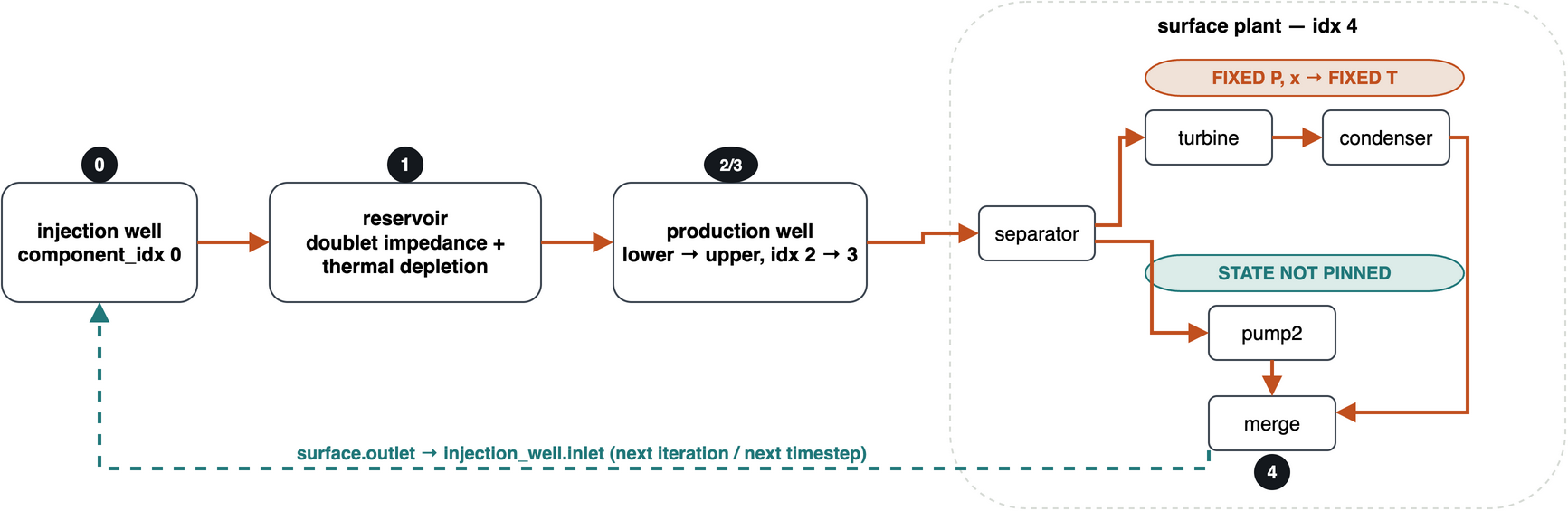
In the single-flash surface plant, the wellhead fluid reaches the injection enthalpy through three paths:
- Separator: the vapor/liquid split is a flash calculation on the enthalpy that arrives from the wellhead, at the valve's fixed outlet pressure. The split sets the mass flow through both branches, so even the branch with a pinned outlet state carries a wellhead-dependent mass weighting into the merge.
- Condenser branch: its outlet temperature, pressure and enthalpy are pinned boundary conditions, independent of the wellhead. Its mass flow is not (see the separator).
- Liquid branch (via
brine_pump): neither its state nor its mass flow is pinned; both depend on the reservoir and production-well output.
B. The convergence loop
Because the reservoir's output reaches the injection enthalpy through the merge, the reservoir is re-solved on every attempt, like every other component.
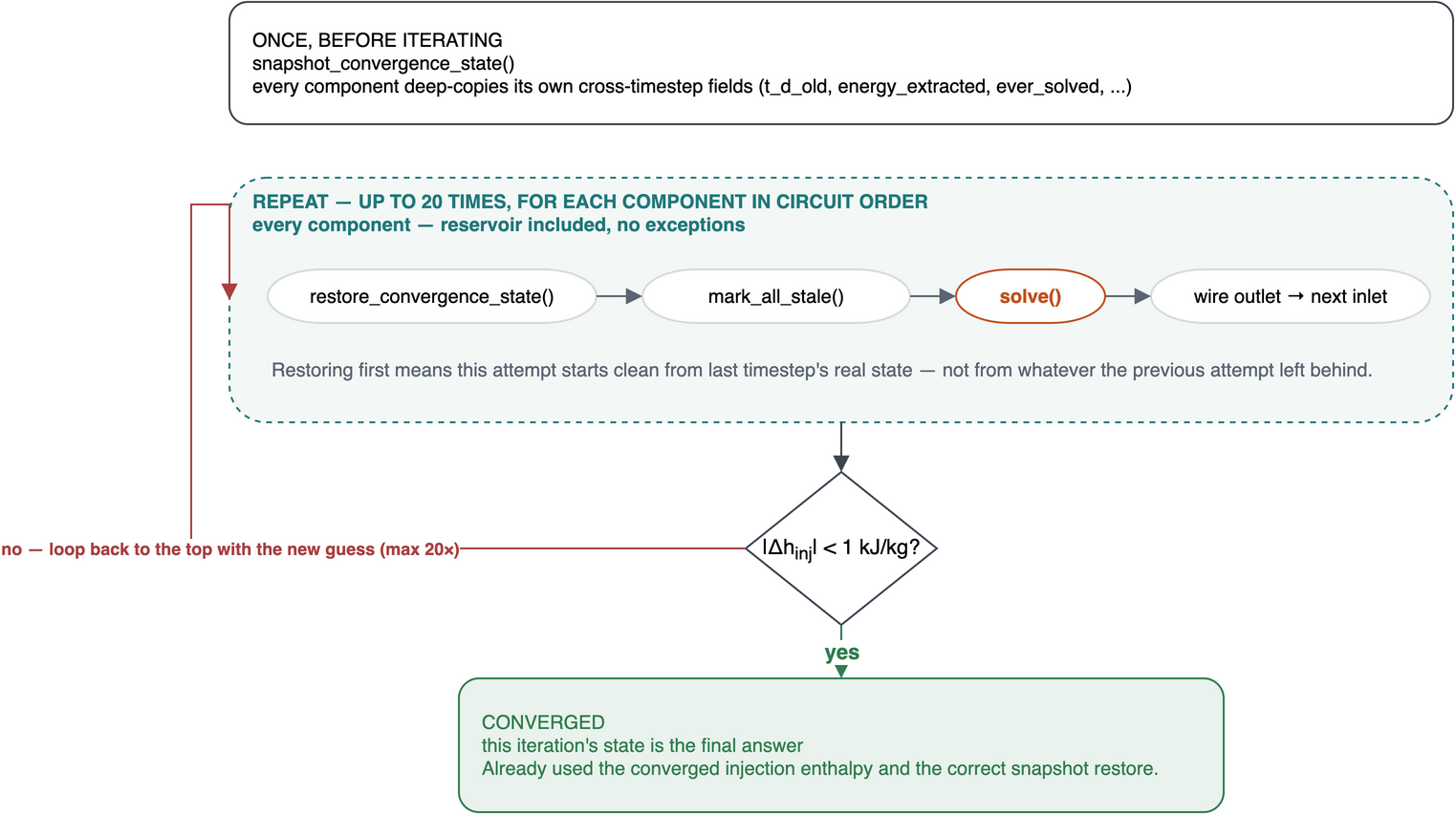
snapshot_convergence_state(), once, before iterating. Every component deep-copies its wholestate, including cross-timestep accumulators such asLumpedReservoir'senergy_extractedandever_solvedandNumericalWell's dimensionless timet_d. The snapshot is the state as committed at the end of the previous timestep.- For each component, in circuit order, on every attempt and with no
exceptions:
restore_convergence_state()→mark_all_stale()→solve()→ wire the outlet to the next inlet. Restoring first means each attempt starts from last timestep's state, not from what the previous attempt left behind. - Check the injection enthalpy after each full pass: if
|Δh_inj| < 1 kJ/kg(_DH_SURFACE_TOL), the loop has converged. Otherwise the next guess comes from Aitken relaxation (core/accelerators.py::aitken_relax), and the loop repeats, up to 20 attempts (DEFAULT_MAX_INNER_ITER). After 20 attempts it raisesConvergenceError. The tolerance is absolute because enthalpy's zero point is an arbitrary reference state. It is on enthalpy rather than temperature because near a fluid's critical point the temperature can stop changing while the enthalpy is still off by several kJ/kg. - The converged pass is the result. It used the converged enthalpy and started from a clean restore of the snapshot.
If a guess drives the fluid below its freezing point, CoolProp raises a "Tmelt" error. The loop then resets the guess to the enthalpy at 275 K and retries.
Implementation: core/component.py (snapshot_convergence_state,
restore_convergence_state) and orchestrators/system_bc_iteration.py
(_converge_injection_enthalpy).